
Mental disorders and Mitochondria
It is quite intuitive to think that energy is essential to mental health!
It is therefore intuitive to think that, mitochondrial dysfunction is involved in mental disorders!
Mitochondria and Depression
* Mutations such as MTHFR, common in patients with recurrent depression, affect vitamin B9 metabolism and mitochondrial function. (70% of the depressed population tested positive for the C677T MTHFR polymorphism)

Psychiatric disorders, such as major depressive disorder, bipolar disorder, and schizophrenia, are now recognized as complex systemic conditions in which mitochondrial dysfunction and oxidative stress are key contributors to their pathophysiology.
Mitochondria, in addition to their role in ATP synthesis, are critical for calcium regulation, immune responses, and apoptosis, and their impairment affects brain function. This review examines current evidence from transcriptomics, metabolomics, neuroimaging, and preclinical studies, which consistently show disruptions in oxidative phosphorylation, mitochondrial fragmentation, altered mitochondrial DNA, and increased inflammatory activity in these disorders.
Mitochondria, oxidative stress, and psychiatric disorders: an integrative perspective on brain bioenergetics; by Paulo Iury Gomes Nunes, at. al; 2025
Mitochondria and Neurotransmitters
Relationships between mitochondrial dysfunction and neurotransmission failure in Alzheimer’s disease.
Monoaminergic neurotransmission is a diverse network consisting of serotonergic, dopaminergic, norepinephrinergic, and histaminergic systems. Mitochondrial dysfunctions are associated with monoaminergic inactivity through various mechanisms.
Kan Yin Wong1 2020 https://www.aginganddisease.org/EN/10.14336/AD.2019.1125
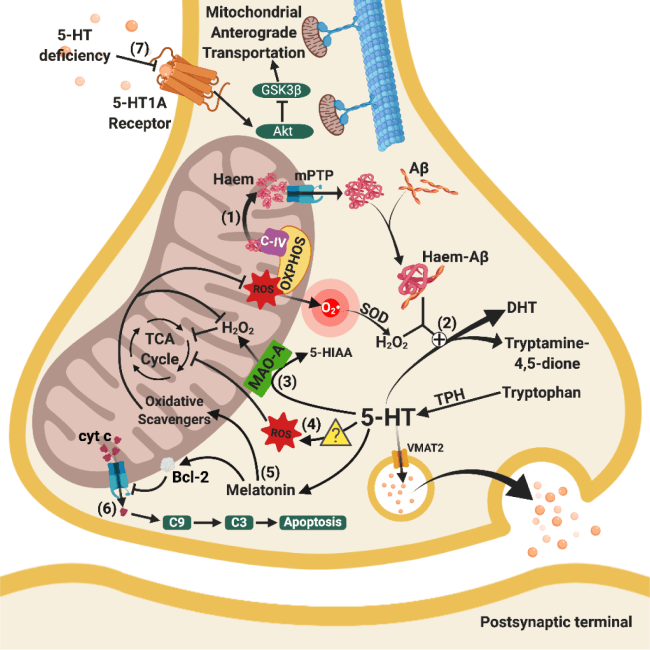
Mitochondrial dysfunctions and serotonergic pathways.

Mitochondrial dysfunctions and dopaminergic pathways.
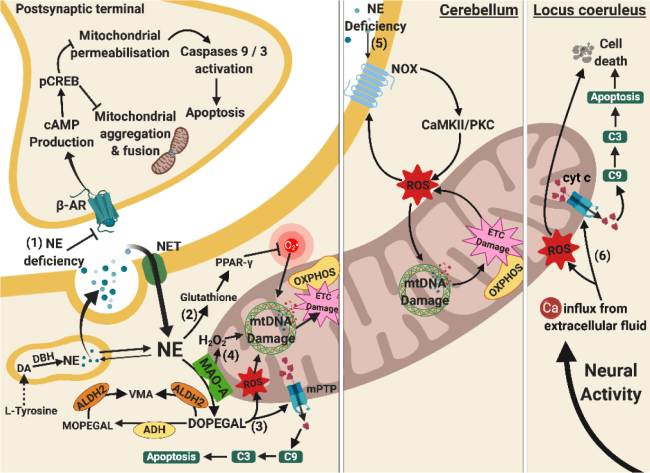
Mitochondrial dysfunctions and norepinephrine pathways.
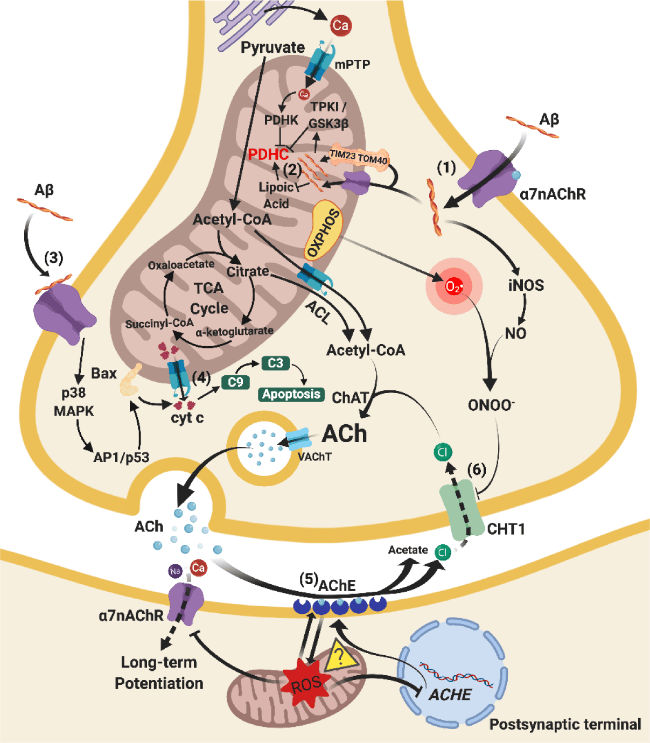
Mitochondrial dysfunctions and cholinergic pathways.
